Executive Summary
The Future of Enterprise AI in 2026: Artificial intelligence has officially transitioned from experimental pilot projects to core enterprise infrastructure. As organizations scale generative models and autonomous agents across global operations, business leaders face critical choices around architecture, data governance, cost management, and regulatory compliance.
This comprehensive report examines the core technological shifts driving enterprise AI adoption in 2026, offering actionable implementation frameworks for technology executives.
1. The Rise of Agentic AI Workflows
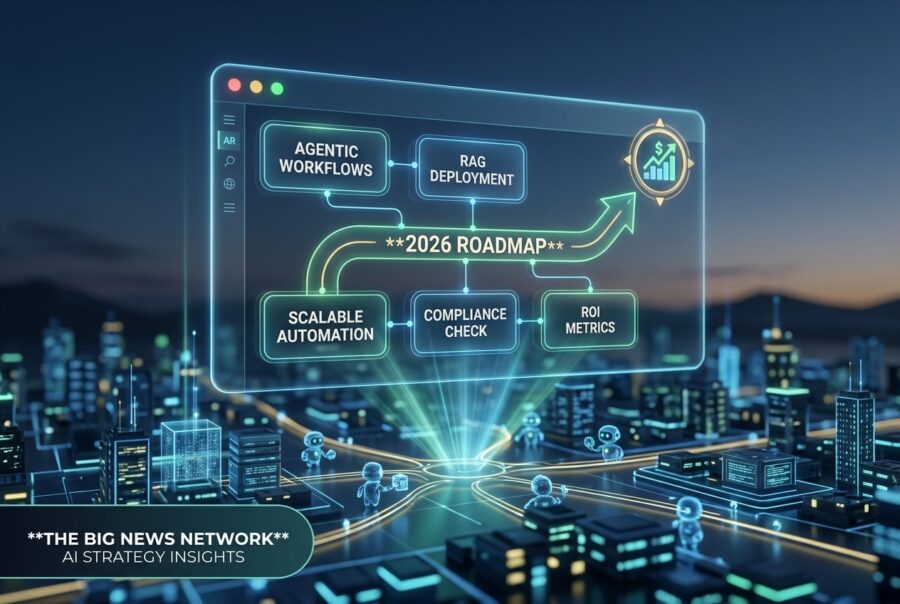
Unlike early generative AI implementations that relied on simple prompt-and-response interactions, modern enterprise platforms utilize agentic workflows. These autonomous systems execute multi-step business logic without requiring continuous human intervention.
[Trigger Event] ──► [Task Orchestration Engine] ──► [Multi-Agent Collaboration] ──► [Human-in-the-Loop Approval] ──► [System Execution]
Key Components of Agentic Systems
-
Autonomous Planning: AI agents break high-level business directives into sequential, actionable tasks.
-
Tool Integration: Direct API connectivity allows agents to query databases, update CRM systems, and trigger financial transactions.
-
Multi-Agent Collaboration: Specialized sub-agents handle specific domains (e.g., data analysis, code review, compliance validation) before synthesizing results.
2. Infrastructure Architecture: Fine-Tuning vs. RAG vs. Custom SLMs
The Future of Enterprise AI in 2026: Organizations must carefully balance model performance against deployment costs. Selecting the right technical architecture depends on data confidentiality, real-time requirements, and budget constraints.
| Technology | Best Use Case | Primary Advantage | Major Limitation |
| Retrieval-Augmented Generation (RAG) | Knowledge bases, customer support, policy search | Real-time ground truth updates without retraining | Latency overhead and retrieval vector database costs |
| Fine-Tuned Open Models | Niche domain tasks, proprietary language formats | High accuracy on specific corporate datasets | Upfront compute cost for training iterations |
| Small Language Models (SLMs) | Edge devices, low-latency mobile apps, offline processing | Blazing fast response time and low memory footprint | Reduced general reasoning capacity |
3. Enterprise Data Governance and Regulatory Compliance
With global frameworks enforcing strict oversight on automated decision-making systems, compliance is no longer an afterthought—it must be baked into system architecture from day one.
Compliance Checklist for IT Leaders
-
[ ] Data Lineage Tracking: Maintain immutable logs detailing which datasets were used to train or fine-tune internal models.
-
[ ] Bias Mitigation Audits: Run quarterly algorithmic auditing to identify bias across automated decision engines.
-
[ ] Opt-Out & Erasure Mechanisms: Ensure customer data can be removed from vector stores and fine-tuning pipelines upon request.
-
[ ] Explainability Layers: Implement model interpretability tools to provide clear audit trails for automated financial or operational decisions.
4. Measuring ROI: Moving Beyond Cost Savings
While workforce automation initially drove enterprise AI investments, leading companies in 2026 evaluate ROI through revenue expansion and speed-to-market metrics:
-
Time-to-Market Reduction: Accelerated software delivery lifecycles using automated code synthesis and testing.
-
Customer Retention Lift: Hyper-personalized support interactions reducing churn across enterprise accounts.
-
Operational Velocity: Faster procurement cycles and automated vendor agreement reviews.
Frequently Asked Questions (AEO Optimized)
What is agentic AI in enterprise software?
The Future of Enterprise AI in 2026: Agentic AI refers to autonomous software agents capable of breaking complex goals into multi-step tasks, evaluating decisions, using external tools via APIs, and completing workflows with minimal human intervention.
How does Retrieval-Augmented Generation (RAG) protect corporate data privacy?
RAG allows enterprise models to access internal documents stored in secure, private vector databases without sending sensitive proprietary data back to public model providers for retraining.
What is the difference between an LLM and an SLM?
Large Language Models (LLMs) feature hundreds of billions of parameters, offering high general reasoning skills at higher compute costs. Small Language Models (SLMs) focus on specific domains with optimized parameters, enabling lower latency, offline functionality, and significantly reduced operational costs.
Editorial Disclaimer
Disclaimer: The information provided in this article by The Big News Network (
thebignewsnetwork.com) is intended strictly for educational, news reporting, and analytical purposes. It does not constitute formal legal, technical, or financial advice. Readers should consult certified enterprise IT architects and legal advisors before implementing complex AI systems or software deployments.
Main Sources & Primary References
-
Big News Network Global News Service: Primary syndication wire and global digital reporting desk (
bignewsnetwork.com/bignewsnetwork.net). -
Corporate Entity Information: Published under the parent operations of Big News Network FZ LLC (Dubai, UAE) and Mainstream Media Limited (UK).
-
Industry Benchmarks: Official documentation and technical whitepapers from major AI research labs and enterprise technology standards organizations.

Daniel Brooks is a digital journalist and content writer at TheBigNewsNetwork.com, covering breaking news, business, technology, lifestyle, entertainment, and emerging trends. He focuses on delivering clear, engaging, and informative content that helps readers understand current developments and discover useful insights. His goal is to make complex topics accessible through well-structured, reader-focused articles.