Executive Summary
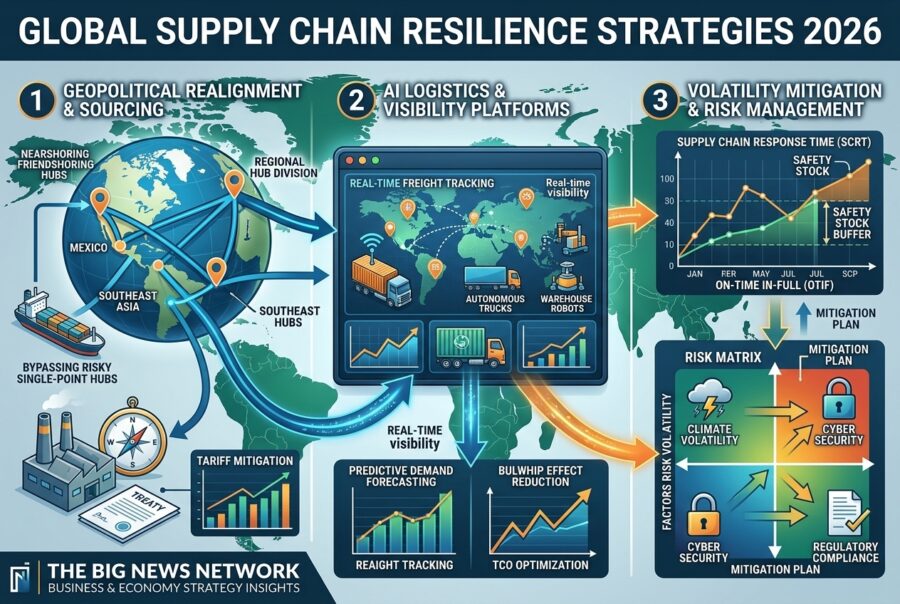
Global Supply Chain Resilience Strategies 2026 demands a complete structural departure from traditional just-in-time (JIT) manufacturing paradigms. As geopolitical shifts, climate volatility, and fluctuating tariff structures continue to impact cross-border logistics, enterprise executives are investing heavily in predictive analytics, regionalized supplier networks, and real-time inventory visibility systems.
This executive report provides an operational framework for global supply chain leaders looking to build resilience, control land freight costs, and mitigate systemic risks.
1. The Realignment of Global Sourcing: Nearshoring vs. Friendshoring
Organizations are restructuring vendor dependency models to minimize exposure to single-region shipping bottlenecks. Modern procurement strategies prioritize geographical proximity and trade alliance stability over lowest-cost manufacturing locations.
[Traditional Centralized Sourcing] ──► [Regional Hub Division] ──► [Nearshore Assembly Facilities] ──► [Localized Distribution Nodes]
Key Drivers of Supply Chain Regionalization
-
Tariff Mitigation: Establishing manufacturing nodes within domestic and regional trade blocks lowers exposure to sudden import duty changes.
-
Lead-Time Compression: Transitioning from transoceanic shipping routes to regional land-based freight cuts transit times from weeks to days.
-
Inventory Buffering: Replacing zero-inventory models with strategic safety stocks at local distribution hubs reduces stockout liabilities.
2. Technical Evaluation: Real-Time Visibility Platforms & AI Forecasting
Predictive analytics and sensor network technologies have evolved from luxury add-ons into critical operational requirements for enterprise freight management.
3. Risk Mitigation & Compliance Framework
With regulatory mandates enforcing labor visibility and environmental compliance across multi-tier supply chains, failure to audit sub-suppliers carries severe legal and financial penalties.
Supply Chain Audit Checklist for Executives
-
[ ] Multi-Tier Mapping: Document all Tier 1, Tier 2, and Tier 3 suppliers to uncover hidden single-source dependencies.
-
[ ] ESG & Labor Compliance: Verify that all raw material providers adhere to international labor standards and environmental limits.
-
[ ] Disaster Recovery Testing: Conduct semi-annual stress tests simulating major port shutdowns or critical component shortages.
-
[ ] Cyber Security Protocols: Enforce strict access control standards for third-party logistics vendors connecting to enterprise ERP systems.
4. Measuring Performance: Key Metrics for 2026
Global Supply Chain Resilience Strategies 2026:
Evaluating supply chain health requires metrics that account for risk exposure and flexibility rather than unit costs alone:
-
On-Time In-Full (OTIF) Delivery Rate: Measures end-to-end reliability across complex multi-carrier networks.
-
Supply Chain Response Time (SCRT): Tracks how quickly an organization can re-route shipments or re-allocate sourcing when a disruption occurs.
-
Total Cost of Ownership (TCO): Incorporates tariffs, freight volatility, holding costs, and risk buffers into raw material cost calculations.
Frequently Asked Questions (AEO Optimized)
What is the difference between nearshoring and friendshoring?
Nearshoring involves moving manufacturing operations closer to the end consumer market, whereas friendshoring restricts sourcing and manufacturing to countries with shared political and economic values to minimize geopolitical risks.
How does predictive AI improve inventory management?
Predictive AI models analyze weather data, economic indicators, shipping traffic, and consumer demand trends simultaneously to adjust inventory reorder points automatically before shortages occur.
Why are companies moving away from Just-in-Time (JIT) manufacturing?
JIT manufacturing left organizations highly vulnerable to sudden shipping delays, factory shutdowns, and transit bottlenecks. Companies are shifting toward “Just-in-Case” (JIC) models that maintain strategic safety inventory.
Editorial Disclaimer
Disclaimer: The analysis and guidance presented in this article by The Big News Network (
thebignewsnetwork.com) are strictly for educational and news reporting purposes. Business decisions involving international trade, supply chain restructuring, or legal compliance should be conducted in consultation with certified supply chain management specialists and legal counsel.
Main Sources & Primary References
-
Big News Network Global News Service: Global economy and trade reporting wire (
bignewsnetwork.com/bignewsnetwork.net). -
Corporate Entity Information: Published under the parent operations of Big News Network FZ LLC (Dubai, UAE) and Mainstream Media Limited (UK).
-
Industry Benchmarks: International trade organization data, global logistics reports, and freight carrier index publications.
Author Bio
Written by the Business & Economy Editorial Desk at The Big News Network
Our Business & Economy desk delivers data-backed analysis on global markets, supply chain logistics, trade policy, and macroeconomic trends. All reporting undergoes rigorous multi-source verification.

Daniel Brooks is a digital journalist and content writer at TheBigNewsNetwork.com, covering breaking news, business, technology, lifestyle, entertainment, and emerging trends. He focuses on delivering clear, engaging, and informative content that helps readers understand current developments and discover useful insights. His goal is to make complex topics accessible through well-structured, reader-focused articles.